Tales of the Texas Rangers
What Made It Different
Most radio Westerns planted their stories somewhere between the frontier era and the Mexican Revolution, and that was fine — audiences knew what they were getting. Tales of the Texas Rangers did something sharper: it set its cases in the modern world, with stories drawn from actual Ranger files spanning 1928 to 1948. Ranger Jace Pearson didn't ride the open range looking for cattle rustlers. He pursued criminals by automobile, with a horse trailer hitched to the back so he could switch to horseback when the chase moved into back country. That combination of Ford sedan and saddle horse was the show's core image, and it told you everything about what the creators were going for — a West that had moved into the 20th century but hadn't entirely left the 19th behind.
The show borrowed its procedural approach directly from Dragnet, following the step-by-step tracking of a criminal by a lawman well versed in modern investigative technique. Where Jack Webb's Sergeant Friday worked the streets of Los Angeles, Jace Pearson worked the wide-open terrain of Texas, and at the end of each episode the announcer gave the case's disposition in the same flat documentary style: "sentenced to life imprisonment at Huntsville." In that context, "Huntsville" needed no further explanation — it was synonymous with the Texas state penitentiary, and the audience understood it.
The opening signature set the tone immediately: "Texas!... More than 260,000 square miles! And 50 men who make up the most famous and oldest law enforcement body in North America!" Those 50 Rangers were real, the cases were real, and the show made sure the audience knew both.
How It Got on the Air
The series was the work of producer-director Stacy Keach Sr., a drama teacher turned Hollywood director who had come west in the 1940s to work at the Pasadena Playhouse and later as a dialogue coach for Universal. He first developed the idea as a potential motion picture before redirecting it toward radio. Getting the Texas Rangers themselves on board was the first challenge — the organization had a reputation for being publicity-shy — and Keach secured their cooperation before the project had a broadcast home.
With that agreement in place, Keach and writer Joel Murcott traveled to Texas to do the research properly. They covered 1,500 miles, watching Rangers work actual case investigations. In Texas, Keach met Captain M. T. "Lone Wolf" Gonzaullas, a 30-year Ranger veteran described as "the last of the old quick-draw artists," who agreed to serve as the show's technical adviser. Gonzaullas was not a symbolic figurehead. He had spent his career as an early advocate of forensic science, introducing the Rangers to ballistics testing, paraffin tests, and other scientific crime-fighting techniques, and was credited with creating a state crime laboratory described as second only to that of the FBI. His influence on the show's procedural credibility was real and specific.
The series was produced by Screen Gems, a division of Columbia Pictures, and premiered on NBC on July 8, 1950. Wheaties sponsored the first two months. The show aired Saturdays at 9:30 through early October 1950, then shifted to Sundays, eventually settling into a Sunday 6 o'clock slot from September 1951 through its final broadcast on September 14, 1952. Murcott handled the writing for most of the run, with Charles E. Israel credited on multiple surviving episodes from the final months in 1952.
Joel McCrea and the Role of Jace Pearson
Joel McCrea was already a working film actor when he came to this show — he had been in pictures since the late 1920s, appearing in over 100 films that included Alfred Hitchcock's Foreign Correspondent and Preston Sturges' Sullivan's Travels. After starring in The Virginian in 1946, he made Westerns almost exclusively, and he later said he felt more comfortable in a Western than any other kind of role. His grandfather had driven stagecoaches and fought against the Apaches. McCrea himself raised horses and operated a 3,000-acre ranch in Ventura County, and he was a proficient horseman long before he played Jace Pearson. He had two stars on the Hollywood Walk of Fame — one for motion pictures, one for radio.
Born November 5, 1905, in South Pasadena, California, McCrea started out as a stunt double and extra while attending Hollywood High School, went on to Pomona College, and landed his first real speaking part in The Jazz Age in 1929. By the time he was playing Ranger Pearson, he was in his mid-forties — exactly the right age for a character described as the personification of the Rangers, whose membership requirements included being at least 30 years old, demonstrating maturity, intelligence, and physical stamina.
The character was structured as a recurring hero within what was essentially an anthology. Each episode was a different case, but the same Ranger worked them all — and the cases' 1928–1948 span fit neatly within a single working career. After each episode's story ended, McCrea came back on to share a piece of Ranger lore with the audience, a small but effective touch that reinforced the show's documentary ambitions. His horse was named Charcoal.
The Supporting Cast and Production Team
The show drew on a deep bench of Hollywood radio performers — Tony Barrett, Peggy Webber, Ed Begley, Herb Vigran, Barney Phillips, Ken Christy, Frank Martin, Reed Hadley, Wilms Herbert, and Lurene Tuttle in the regular rotation, with Virginia Gregg, Howard McNear, Parley Baer, Paul Frees, and Betty Lou Gerson turning up across various episode-level records. Hal Gibney handled announcing duties. Monty Fraser was responsible for sound effects, and the show used "The Eyes of Texas Are upon You" as its theme.
Captain Gonzaullas brought more than a title to his technical advisory role. He had joined the Texas Rangers on October 1, 1920, becoming the first Ranger captain of Hispanic ancestry to hold that rank, and earned his "Lone Wolf" nickname early enough that the first printed reference appeared in the Wichita Falls Daily Times in December of that same year. He retired from the Rangers in 1951 — just as the radio series was running — and moved to Los Angeles, where he spent roughly five years as a consultant to radio, television, and film productions. He was also a co-founder, in 1968, of the Texas Ranger Hall of Fame and Museum in Waco.
Pearson's working method on the radio series was notably collaborative for a lone-hero format. Rather than operating independently, he frequently worked alongside local sheriffs' offices and police departments, called in by request. That detail was consistent with how the actual Rangers operated, and it grounded the show's cases in the kind of institutional reality that gave Dragnet its appeal.
After the Radio Run
Tales of the Texas Rangers ran for 95 regular episodes plus one audition recorded April 19, 1950 — before McCrea was attached — that starred Frank Martin in the lead role. Ninety-two of the 95 survive; three episodes, numbered 16, 29, and 41, are missing, with no surviving titles for any of them.
The franchise didn't stop at radio. A television adaptation aired on CBS starting in September 1955, produced by Screen Gems with Keach again producing and directing several episodes. The TV version ran 52 episodes over three seasons before moving to ABC in 1957, where it continued into late 1958. Willard Parker played Jace Pearson for all 52 television episodes, with Harry Lauter as his partner, Ranger Clay Morgan — a character who had been an occasional supporting figure in the radio version and was elevated to a permanent co-starring role for television. The TV series alternated between stories set in the 1840s and stories set in the contemporary 1950s, billing itself as a survey of the Rangers' 120-year history.
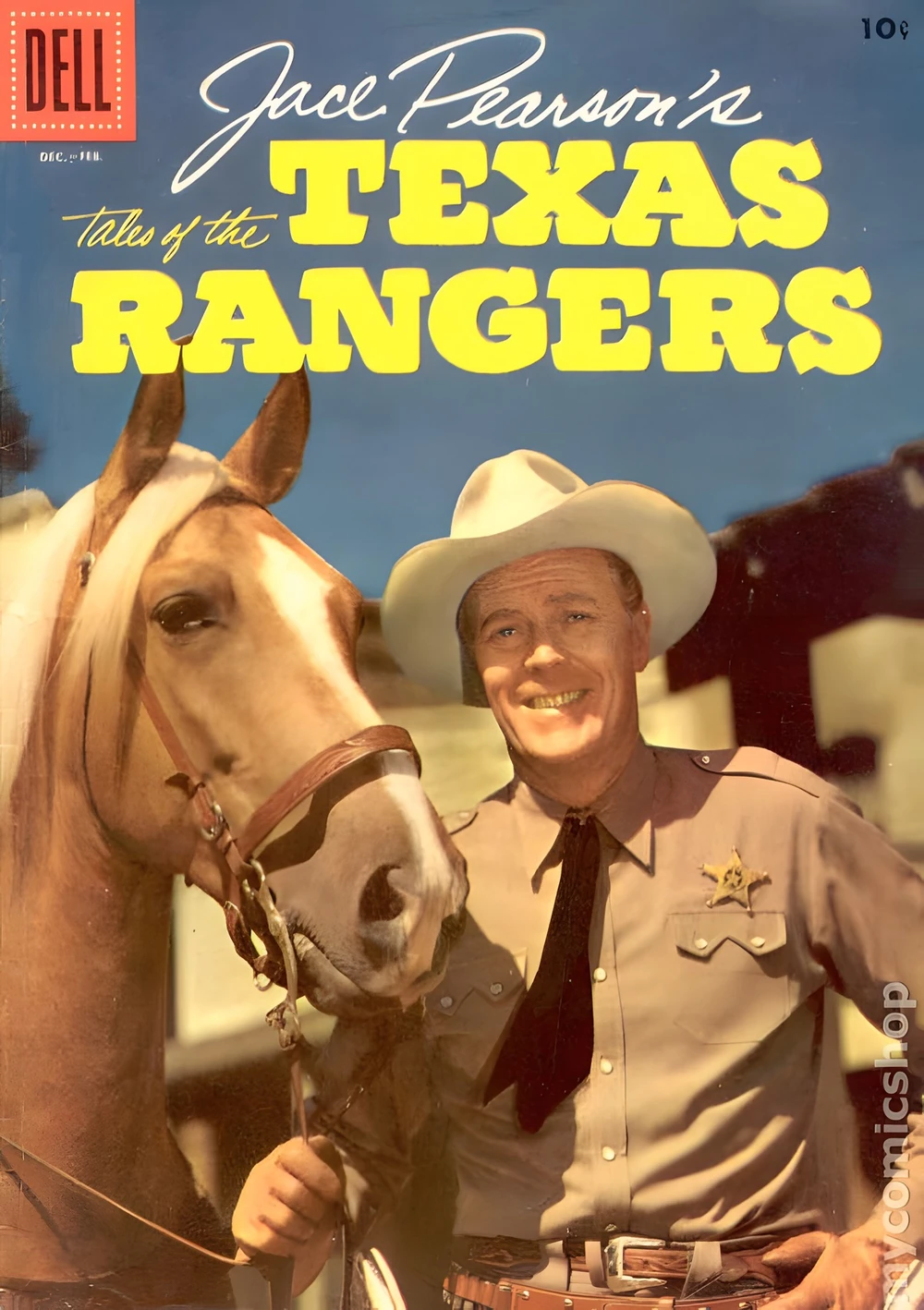
Dell Comics published a tie-in series beginning in 1952. The first issue — Dell Four Color #396, with art by Tom Cooke — bore the show's radio title; starting with the second issue in 1953, it ran as Jace Pearson of the Texas Rangers. The series continued quarterly until 1959, running approximately 22 issues. The first ten featured McCrea on the covers; subsequent covers featured Parker. Artist Dan Spiegle, who drew a number of Dell's Western licensed-property titles, worked on the comic throughout its run. Stacy Keach Sr. held the copyright from the beginning.
McCrea outlived the show by nearly four decades, dying in Woodland Hills, California, on October 20, 1990. Gonzaullas had gone before him, in Dallas on February 13, 1977, and Keach Sr. followed in Burbank on February 13, 2003. His son, actor Stacy Keach Jr., has said his father "created, produced and directed the legendary Tales of the Texas Rangers for NBC Radio in the early 1950s." The 92 surviving episodes remain the most complete record of what the show actually was.